Sanssouci
Palace · Brandenburg, Germany · Built from 1745
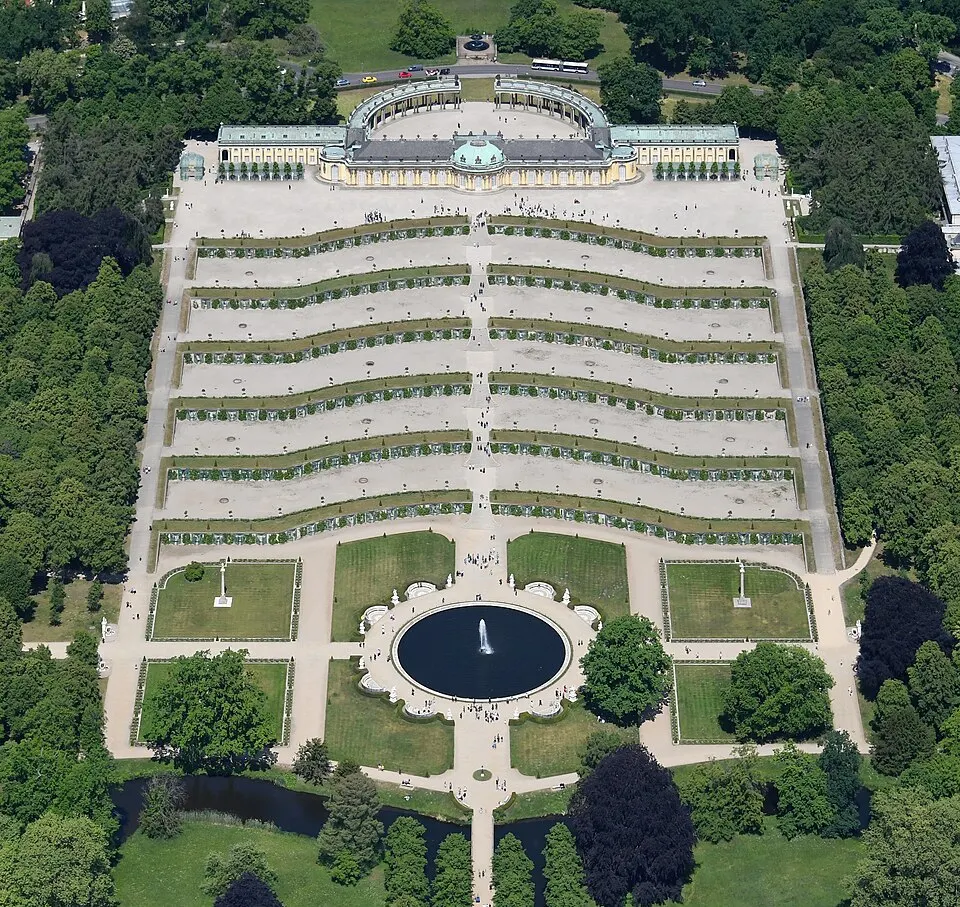
Frederick the Great's intimate Rococo summer palace above vineyard terraces: the 'Prussian Versailles' and a UNESCO World Heritage Site in Potsdam.
Interesting facts
- Frederick had his crypt built on the top terrace as early as 1744, before construction of the palace had even begun.
- Visitors leave flowers and potatoes on Frederick's simple gravestone, recalling his potato decree.
- Curiously, the gilded name on the garden façade is written with a comma and a full stop: 'Sans, Souci.'
- The round, cedar-panelled library holds around 2,100 volumes, centred on the works of Voltaire.
- Frederick never saw the Great Fountain working – only a century later did steam power finally make it play.
History
Frederick the Great had the summer palace built to his own sketches by Georg Wenzeslaus von Knobelsdorff between 1745 and 1747, above a specially created vineyard; he spent his summers here and died here in 1786. During the French occupation of 1806, Napoleon placed the palace under his protection. Frederick William IV, an admirer of Frederick the Great, had the side wings enlarged in 1841/42 and died here in 1861; after 1873 Sanssouci became one of Germany's oldest palace museums. The building survived the Second World War undamaged, though many artworks were taken to the Soviet Union as booty; it has been a UNESCO World Heritage Site since 1990, and in 1991 Frederick was buried here.
Plan your visit
Maulbeerallee, 14469 Potsdam, 14469 Potsdam, Deutschland
Current opening hours and tickets are on the official website.